What is the Trajectory Analysis?
What is the Trajectory Analysis? Scientific researchers are generally concerned with the trajectory of the variable over time, but also with the effects of covariates.
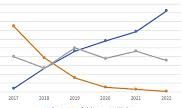
A trajectory describes the change, course, of the measured variable with respect to time and age. Scientific researchers are generally concerned with the trajectory of the variable over time, but also with the effects of covariates.
Relationships of variables over time can be studied with traditional methods (e.g. hierarchical modeling, curve analysis, etc.). However, nowadays, with the expansion of the literature, group-based trajectory models are preferred more than traditional methods. Group-based trajectory modeling methods are applied by assuming that the population consists of groups with different basic characteristics. They define groups by tracking similar changes of some phenomena that change over time and model the effects of covariates on trajectory shape and group members.
The most important advantage of trajectory analysis is that possible phenomena changes in future time periods can be predicted with results in different time periods. For example, by examining the data of a group of patients diagnosed with X disease, a risk assessment can be made for future time periods — such as the next 5 years — according to the data collected during the follow-up of other individuals. Trajectory analysis is therefore of great importance in the field of health.